Tushita Meditation Centre, Dharamkot: Courses & How to Book
Tushita is a Tibetan Buddhist centre in the forest above McLeod Ganj. Here is how its free drop-in meditation works, what the 10-day Introduction to Buddhism course is like, how to book each course, what it costs and where to stay.
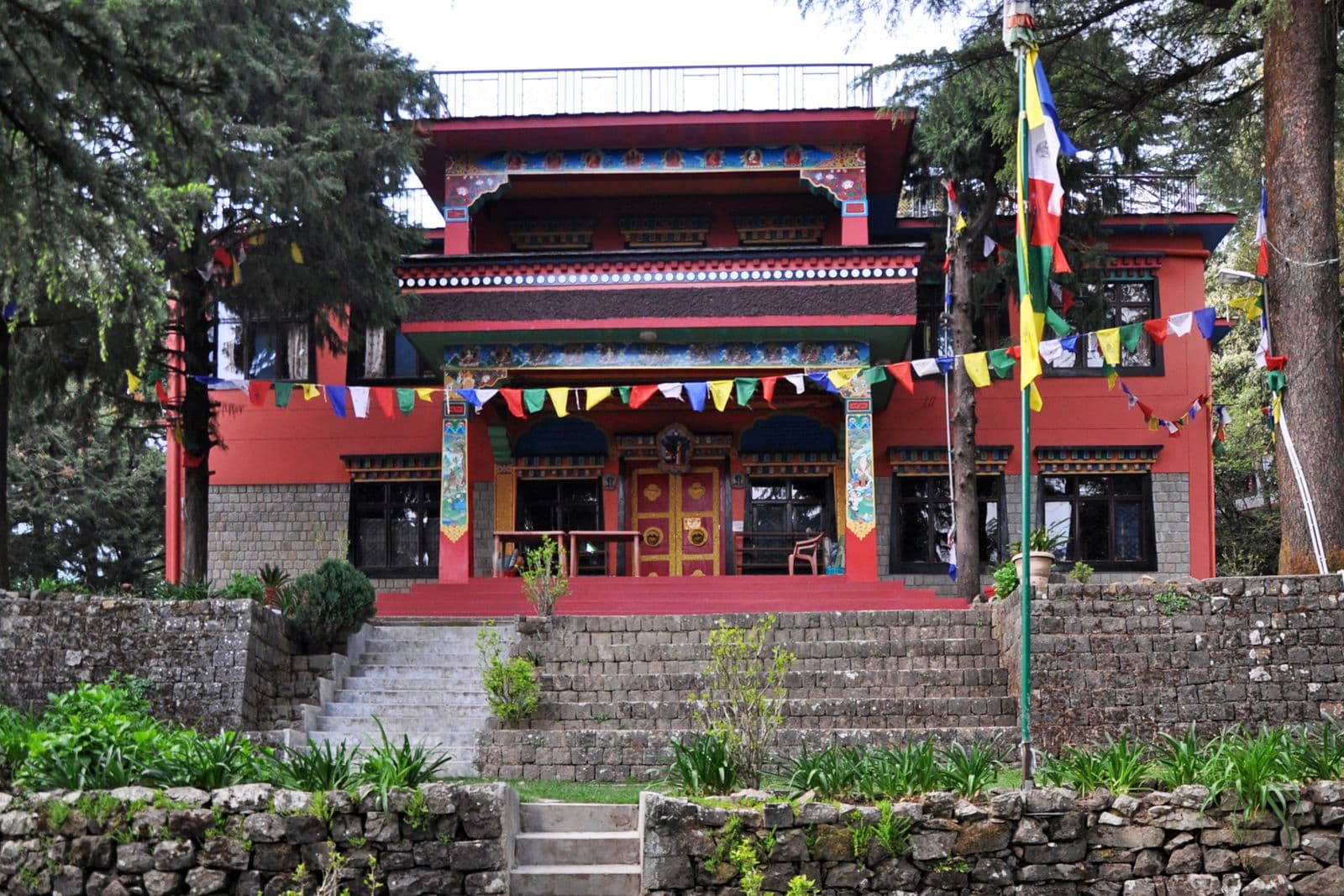
Short answer: Tushita Meditation Centre, an FPMT Tibetan Buddhist centre above McLeod Ganj near Dharamkot, offers a drop-in guided meditation Monday to Saturday at 9am (about an hour, no booking, by donation). For longer study, book the residential 10-day Introduction to Buddhism online, or a weekend short course in person at the office. Tushita is open February to November and closed in December and January.
Tushita Meditation Centre is a centre for Buddhist study and practice in the Tibetan Mahayana tradition. It belongs to the FPMT network and sits in deodar forest on the road from McLeod Ganj up to Dharamkot. There are two ways in. The first is the drop-in guided meditation, which runs Monday to Saturday from 9am for about an hour and needs no booking. The second is a course: the residential 10-day Introduction to Buddhism, which you book online, or a weekend short course, which you book in person at the reception office. Tushita is open from February to November and closed in December and January.
This guide covers each option, how and when to book, what it costs, how to get there and where to stay. If you are still choosing between Tushita, Vipassana and yoga, start with our meditation and yoga retreats guide. For a wider view of temples, monasteries and practice in the area, see monasteries and meditation in Dharamshala.
Quick facts
| Location | Above McLeod Ganj, next to Dharamkot village, about 1,888 m |
| Tradition | Tibetan Mahayana Buddhism, FPMT centre |
| Drop-in meditation | Monday to Saturday, 9am, about one hour; no registration; by donation |
| Course types | 10-day residential Introduction to Buddhism; 2–3 day non-residential short courses; intermediate courses and group retreats |
| How to book | Introduction to Buddhism: online registration form. Short courses: in person at the office only, not by email |
| Cost basics | Runs on donations with minimum amounts per course, paid in Indian rupees only (see below) |
| Office hours | Monday to Saturday, 9:30–11:30am and 12:30–4pm; closed Sundays |
| Season | Open February to November; closed December and January |
The drop-in guided meditation
This is the easiest way to see Tushita, and many people come back after their first morning. A guided session starts at 9am, Monday to Saturday, and lasts about an hour. It is led by experienced students rather than monks or visiting teachers, and it is aimed at complete beginners as well as people who already meditate. The focus is on settling the body and mind and looking at how attention works.
No registration is needed. Just turn up a few minutes early. The hall changes depending on which courses are running, so check the sign on the window of the reception office and follow the yellow arrows along the path. Sessions are offered on a donation (dana) basis; there is a box at the back of the hall.
A few points to know:
- There is no session on Sundays.
- The drop-in is cancelled during short courses. These usually fall on a weekend, so check the calendar on tushita.info before walking up on a Friday or Saturday.
- Keep silence anywhere on the grounds. Residential courses are always running nearby. Do not enter a hall where a course is in session, and leave quietly at the end rather than chatting outside.
- Groups of six or more are asked to email the centre in advance so the visit can be timed well.
- Tushita also runs the session online for people who cannot come; the details are on the drop-in page of the official site.
Outside the drop-in hour, visitors can use the library or sit quietly in a vacant hall. Ask at reception which hall is free.
The 10-day Introduction to Buddhism
This is the course Tushita is known for. It is residential and held in a mostly silent retreat setting, and it is suitable for complete beginners as well as people with some background. Teachers explain Tibetan Buddhist philosophy and meditation in a modern way, with a focus on daily life. The topics include the mind and emotions, karma, rebirth, love and compassion, and the nature of reality. All teaching is in English, except for an occasional Hindi-language course. The last two days are given to more intensive meditation.
How often it runs
In 2026 the course ran once or twice in most months from late February to late November. The official 2026 list had fifteen courses. The first began on 23 February and the last two run from 3 to 12 November and 17 to 26 November 2026, with a Hindi course in June. The 2027 dates are published on tushita.info; expect a similar pattern starting in late February.
What a day looks like
- 6am: wake-up gong
- Morning meditation, breakfast, then a teaching session
- Lunch, rest, and on some days a stretching session
- Afternoon teaching and a one-hour discussion group on most days
- Dinner, then evening meditation; the last session ends around 9pm
Check-in is at 1pm on Day One and check-out is at 1pm on Day Ten. If you arrive late, your place can go to someone on the waiting list.
Silence, phones and rules
Tushita calls itself a semi-monastic centre, not a guesthouse, and the rules reflect that:
- Silence from the evening of Day One until the end of the course. Questions are welcome during teaching sessions.
- Phones, laptops, cameras and music players are handed in to the safe at check-in. Your phone cannot be used as an alarm, so bring a watch or small clock. Sort out all travel, money and messages before you arrive.
- You may not leave the grounds during the course, and you must attend every session on time.
- Five precepts: no killing (insects included), no stealing, no lying, celibacy (no hugging, holding hands or massage), and no alcohol, drugs or cigarettes. Smoking is allowed only at one spot on the boundary.
- Dress: shoulders to below the knees covered, including upper arms; no shorts, tank tops or tight clothes.
- In the gompa: no lying down or yoga, do not point your feet at the teacher or altar, and do not put Dharma books on the floor.
Most beds are in dormitories. There are a few single rooms, which are in high demand; students over 50 or with a physical condition can ask for priority, but no room type is guaranteed. Three vegetarian meals are served each day, and special diets are not catered for. Because water is short, you are asked not to do your own laundry; a laundry service is available.
Tushita also asks that students be in good physical and mental health. The course deals with challenging ideas, and the staff are not counsellors. If you are unwell, see a doctor before you arrive.
Shorter non-residential courses
For people with only a weekend, Tushita runs short courses of two or three days, such as How to Meditate. They are non-residential, so you sleep in a guesthouse nearby and walk in each morning. The 2026 autumn list included How to Meditate on 24–25 October and a course on contentment on 14–15 November.
A typical short course day:
| Time | Session |
|---|---|
| 9:00–9:45am | Meditation |
| 10am–12pm | Teaching |
| 12–2pm | Lunch break |
| 2–4pm | Teaching |
| 4–4:20pm | Tea |
| 4:20–5pm | Meditation |
Times can change at short notice. Lunch and afternoon tea are included on course days. Phones, cameras and music players are not allowed in sessions, and you keep silence, dress modestly and attend everything. Intermediate courses and group retreats are open to people who have done an Introduction to Buddhism.
How and when to book
The method depends on the course, and getting it wrong is the most common mistake.
Introduction to Buddhism: online. Read the course information on tushita.info, then fill in the online registration form. Do not email to ask whether places are left; submit the form. Your place is confirmed only when Tushita receives a non-refundable, non-transferable deposit of 2,000 INR. Register as soon as your dates are certain, because courses fill quickly, and April to June is the busiest stretch. Rooms are allocated in order of registration.
Popular courses have a waiting list, which can start one to six weeks before the course. A place on it is not a promise; Tushita cannot tell you whether you are in until confirmed students have checked in on Day One. Tushita advises people coming from abroad or from far away in India not to rely on the waiting list.
If you book and cannot come, tell Tushita so the place can go to someone else. Anyone who fails to turn up twice is not allowed to register again.
Short courses: in person only. Registration is at the reception office, not by email or online. The office is open Monday to Saturday, 9:30–11:30am and 12:30–4pm, closed Sundays. Pay in the days before the course starts. In practice this means arriving in McLeod Ganj or Dharamkot at least a day early.
Drop-in: no booking. Just turn up at 9am.
What it costs
Tushita runs on donations, but courses have a minimum donation. As of October 2026 the official site gives these figures:
- Introduction to Buddhism, 10 days, dormitory: minimum 8,600 INR, which covers your bed and meals. Single rooms cost more; the minimum depends on room type.
- Deposit for any residential course: 2,000 INR, never refundable.
- Short courses: minimum 1,500 INR for two days or 2,000 INR for three days, including lunch and tea on course days. No refunds.
- Drop-in meditation: by donation, whatever you feel is right.
Pay in Indian rupees only. Tushita does not take cards, foreign currency or traveller's cheques, so withdraw cash in McLeod Ganj before you walk up. For the 10-day course, Tushita refunds the rest of the cost if you leave before 1pm on the first full day; after that there is no refund. A 50 percent scholarship is offered to Tibetan and Indian students aged 18 to 23. Bring about 1,000 INR extra for the library deposit and the small shop. Amounts change, so check tushita.info before you go.
Getting there
Tushita is on the road that climbs from McLeod Ganj to Dharamkot, about five minutes below the village.
- On foot: from the main square in McLeod Ganj it is a steep 15 to 20 minute walk uphill. The road is shaded by forest but is narrow and has traffic, so walk on the edge and carry a torch if you are coming back after dark.
- By taxi or rickshaw: a short ride from McLeod Ganj; Tushita gives about 100 INR by rickshaw as a guide. Ask for Tushita; the gate is on the road.
- From further away: Dharamshala town is 20 to 30 minutes below McLeod Ganj by bus or taxi. The nearest airport is Gaggal (Kangra), and the closest major railhead is Pathankot, about three to four hours by road.
Where to stay nearby
Tushita cannot host anyone before a course, and short-course students must stay outside. Sometimes one extra night after a 10-day course is possible, but this is only confirmed near the end.
- Dharamkot is the closest and quietest choice, five minutes up the road. It has guesthouses, homestays and cafés. See our Dharamkot destination page and Dharamkot travel guide.
- Budget travellers will find dorm beds and private rooms in Dharamkot, Bhagsu and McLeod Ganj on our hostels page.
- McLeod Ganj has the widest choice and is easier for buses and ATMs, at the cost of a steep morning walk. Compare areas in where to stay in Dharamshala.
From March to June, book your room ahead; it is peak season and Tushita itself recommends this.
Etiquette and what to bring
For any visit:
- Dress modestly, covering shoulders and knees.
- Keep silence on the grounds and switch your phone off.
- Take shoes off before entering a gompa, and do not point your feet at the altar.
- Arrive on time; late arrivals disturb a full hall.
For the 10-day course, bring:
- A photocopy of your passport and Indian visa (foreign nationals)
- Warm layers and a good sleeping bag; nights at this height are cold even in spring and autumn
- A shawl or blanket for sitting, toiletries, towel, torch, watch or small clock, and a refillable water bottle
- Enough cash in rupees for the donation, library deposit and small purchases
Our Tibetan culture and etiquette guide explains the wider customs around monasteries, monks and prayer wheels.
Seasons and closures
Tushita is open from February to November and closed in December and January for the winter break. The office and drop-in meditation also close on Sundays. Spring (March to May) and October are the busiest months for courses and accommodation. July and August bring heavy monsoon rain, but courses still run; in 2026 the waiting lists were in May and June rather than July and August. November is cold at night but clear, and the last courses of the year finish in late November.
If Tushita is full or you want a stricter, completely silent retreat, the 10-day course at the Vipassana centre nearby works very differently. See our Dhamma Sikhara Vipassana guide.
Frequently Asked Questions
Do I need to book the Tushita drop-in meditation?
How do I book the Tushita Introduction to Buddhism course?
Can I book a Tushita weekend course by email or online?
How much does Tushita cost?
When is Tushita closed?
Can I keep my phone during the 10-day course?
Can I stay at Tushita without doing a course?
How do I get to Tushita from McLeod Ganj?
More answers on our Dharamshala travel Q&A page.
Where to stay: see our picks of the best hotels in Dharamshala and the best hotels in McLeod Ganj, or compare all hotels and homestays with direct rates.
Need Help Planning Your Dharamshala Trip?
Our local team can help with hotels, treks, taxis, and custom itineraries.
Sources
Checked 2026-10-16. Facts change; confirm on the official pages before you travel.
Related Guides
Meditation & Yoga Retreats in Dharamshala: Tushita, Vipassana, LTWA & More (2026)
An honest guide to meditation, Buddhist study and yoga in Dharamshala and McLeod Ganj: Tushita's courses, the 10-day Vipassana at Dhamma Sikhara, LTWA philosophy classes, yoga in Dharamkot and Bhagsu, costs, seasons and how to choose.
Vipassana in Dharamkot (Dhamma Sikhara): 10-Day Course Guide
Dhamma Sikhara is the Vipassana centre in the forest near Dharamkot, above McLeod Ganj. It runs silent 10-day courses in the S.N. Goenka tradition, free of charge. Here is how the days run, who it suits, how to apply on dhamma.org and how to arrive.
Things to Do in Dharamkot: Tushita, Gallu Devi & Trails (2026)
A local's guide to Dharamkot above McLeod Ganj: Upper vs Lower Dharamkot, Tushita and Dhamma Sikhara, the Gallu Devi start of the Triund trek, cafes, hostels, the Israeli backpacker scene and how to find the quiet side.
Tibetan Culture & Etiquette in McLeod Ganj: A Respectful Visitor Guide (2026)
How Tibetans came to McLeod Ganj, and the etiquette that matters at monasteries, around monks, at prayer wheels and in conversation, plus the institutions worth visiting to understand Tibetan life in exile.