Kangra Slate 2026: Khaniyara Slate Mines, How Slate Roofs Are Made, the Mining Ban and Where to See It
The full story of Kangra slate, from rock to roof: what slate is, where the Dharamshala slate belt lies (Khaniyara, Dari, the Maunjhi and Manauni khads), how it was quarried, split and dressed, why Kangra houses wear grey slate roofs, the court bans and lapsed permissions since the 1990s, what is happening in 2026, and where to see slate roofs respectfully.
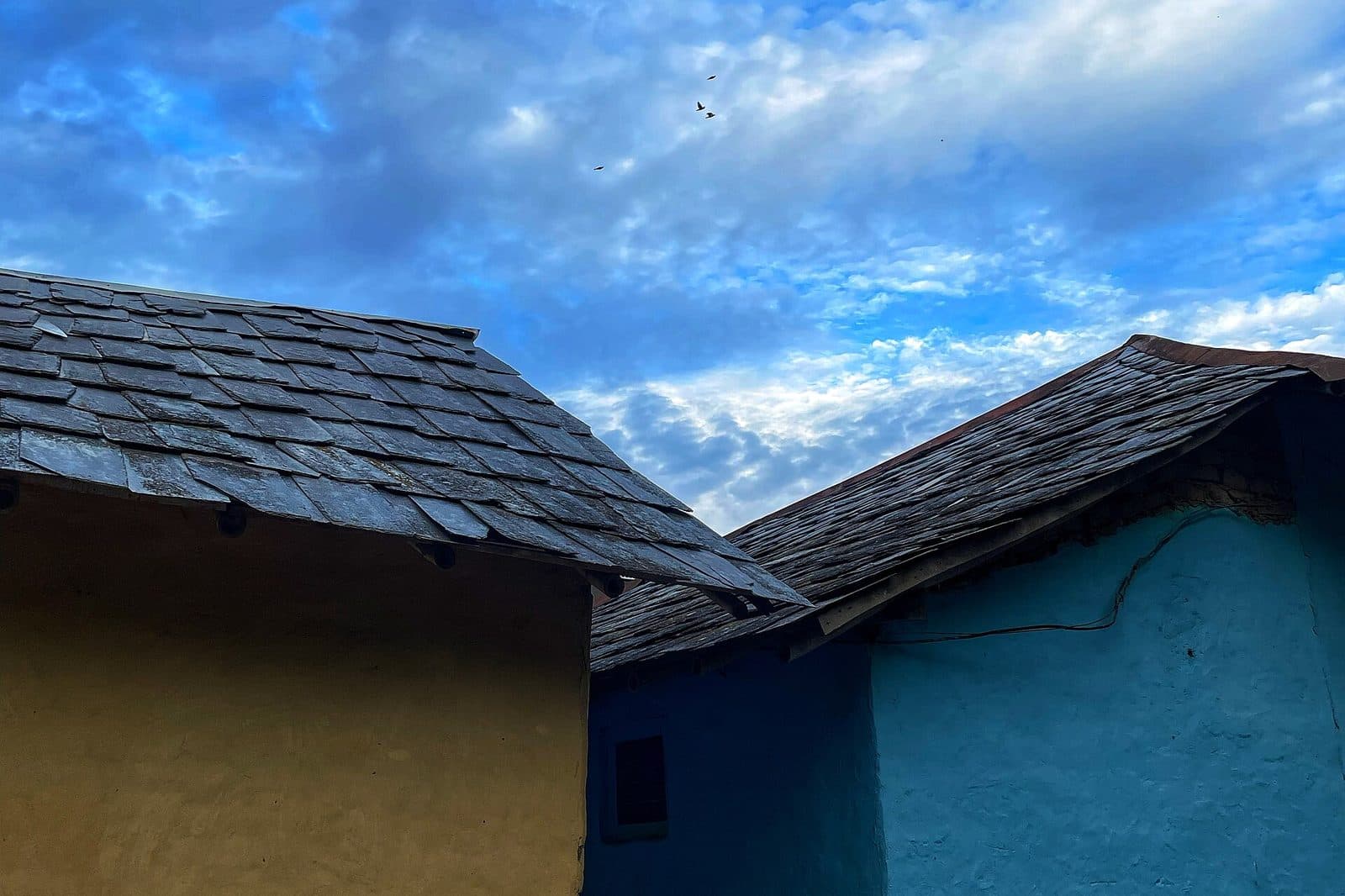
Short answer: Kangra slate is a fine-grained Proterozoic rock (more than 540 million years old) quarried mainly at Khaniyara and Dari, on the southern slope of the Dhauladhar about 7 km from Dharamshala, where mining began around 1850. It was hacked out by hand with crowbars and chisels (and, illegally, explosives), split along its natural cleavage into thin sheets and dressed into the grey roof slates you see on old Kangra houses. A court shut the Khaniyara quarries in the mid-1990s; a 25-hectare permission granted around 2000-2002 lapsed in 2014 when the state did not pay the forest fee, yet illegal mining was still reported in 2015, 2018 and 2019. We could not confirm whether any legal quarry is working at Khaniyara in 2026.
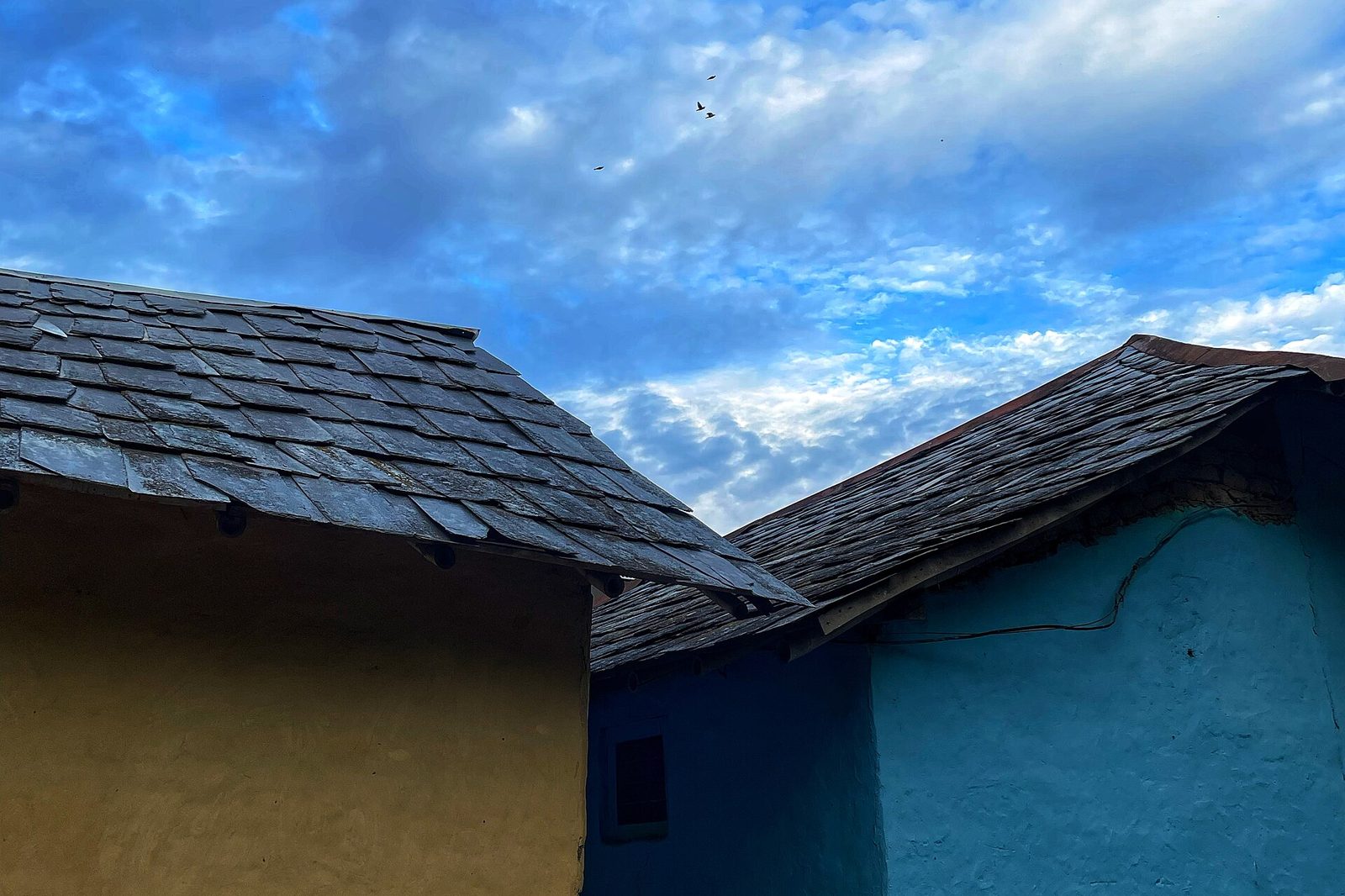
This guide follows the stone from the mountain to the roof, and says clearly what is confirmed and what is not. For the people who built most of these houses, read our Gaddi shepherds culture guide; for the wider valley, see places to visit in Kangra.
Kangra Slate: Quick Facts
| Question | Answer | Source / status |
|---|---|---|
| What is it? | Slate: a fine-grained, cleavable metamorphic rock made from clay and shale | HP Industries Department survey; confirmed |
| How old? | Proterozoic (the eon that ended about 540 million years ago) | IUGS Heritage Stones; Kaur et al. 2020 |
| Which rock units? | Chamba and Katarigali Formations (IUGS); an older state profile says the Chandpur Formation | Sources use different names |
| Main quarry area | Khaniyara and Dari villages, in the Maunjhi, Manauni and Churan khads (streams) | IUGS; Chand et al. 2017 |
| Altitude and distance | Quarries at about 1,800 to 1,950 m, 11 to 15 km north-east of Dharamshala; Khaniyara village about 7 km from Dharamshala | Chand et al. 2017; The Tribune 2018 |
| Other old quarry sites | Bhagsunath (Bhagsu), Thatri, Kareti, Narwana | MSME Kangra profile; ISVS 2023 |
| Mining began | About 1850; the Kangra Valley Slate Company from 1867 | HP Industries Department survey |
| Heritage status | "Himachal Slate" is listed by the IUGS as a Global Heritage Stone Resource (designated 2024) | IUGS |
| Is mining banned? | Court ban since the mid-1990s; 25-ha permission lapsed in 2014; illegal mining reported up to 2019 | The Tribune; status in 2026 not confirmed |
| Can visitors tour a quarry? | No. There is no official tour, and old pits are unsafe | Our advice |
| Where to see slate roofs | Old houses in Khaniyara, Dharamkot, Naddi, Kareri village and Pragpur | See the table below |
What is slate, and how did the Kangra slate form?
Slate is a metamorphic rock. It starts as fine mud and clay laid down in water, which hardens into shale. When that shale is buried and squeezed by regional metamorphism, its tiny flat mica and clay crystals line up at right angles to the squeeze. That alignment gives slate its cleavage: the ability to split into thin, flat, even sheets that have nothing to do with the original bedding layers. That is what makes it a roofing stone.
The Kangra and Chamba slates are Proterozoic in age. According to the International Union of Geological Sciences (IUGS) heritage stone listing, they are made mainly of quartz, feldspar, mica, chlorite and carbonate minerals, with iron sulphides and epidote, and range from green to grey with a bright surface. Freshly split Kangra roofing slate often looks blue-grey to blue-black; Outlook Traveller describes the roofs of Pragpur as "shining blue-black slate".
Which rock unit the slate belongs to depends on whom you read. The IUGS listing, based on a 2020 study by Gurmeet Kaur (Panjab University) and colleagues in the journal Geoheritage, says the Chamba and Katarigali Formations are the main sources for both Chamba and Kangra districts. An older district industrial profile says mining "is confined to the Chandpur formation which consists of phyllites and slates". Both agree on the essentials: an ancient, low-grade metamorphic slate band on the southern flank of the Dhauladhar.
Where is the Dharamshala slate belt?
The slate is not everywhere. It sits in a band on the lower southern slopes of the Dhauladhar, above the town:
- Khaniyara and Dari: the heart of the trade. The quarries lie in three stream valleys, the Maunjhi, Manauni and Churan khads, all feeding the Beas river system, at roughly 1,800 to 1,950 m. A 2017 study describes the quarry belt running about 4.6 km from Khaniyara west towards Bhagsunag.
- Dharamkot: the Himachal Pradesh Industries Department (Geological Wing) records a slate horizon 210 m thick with a strike length of 1,750 m near Dharamkot, with probable reserves of about 9,92,250 tonnes.
- Ab Got: a 40 m thick horizon over 200 m, probable reserves about 21,600 tonnes.
- North of Bhatti: a 60 m thick belt over 100 m, probable reserves about 1,62,000 tonnes.
- Bhagsu, Yol and Narwana: named as old slate areas; a Tribune report from January 2001 said extraction there stayed banned because they had been "declared unfit for mining".
How are slate deposits found?
In Kangra the slate was first found the old way: it shows on the hillside. Outcrops of dark rock that split into thin plates, and streams carrying slate chips, told villagers where to dig, and the state survey notes that "the art of extraction of slates is known to the local people of the area since generation".
Modern mapping does the same job with numbers. The state geologists' survey records each slate horizon with GPS-style coordinates, thickness and strike length (how far the band runs across the hill), then multiplies these to estimate "probable reserves" in tonnes. Good roofing slate needs a band that is thick, even and free of cracks, so a big deposit on paper is not always good roofing stone.
How was Kangra slate quarried and extracted?
Every source we found describes small, hand-worked pits rather than big machine quarries:
- Tools: crowbars, chisels and digging tools, according to a 2017 case study of Khaniyara by Jagdish Chand, Phool Kumar and Promila Devi, and a 2018 report on the High Court local commissioner’s findings.
- Pits: pits of about 3 to 4 m down dip (dug down along the slope of the rock layers), each worked by 10 to 15 labourers.
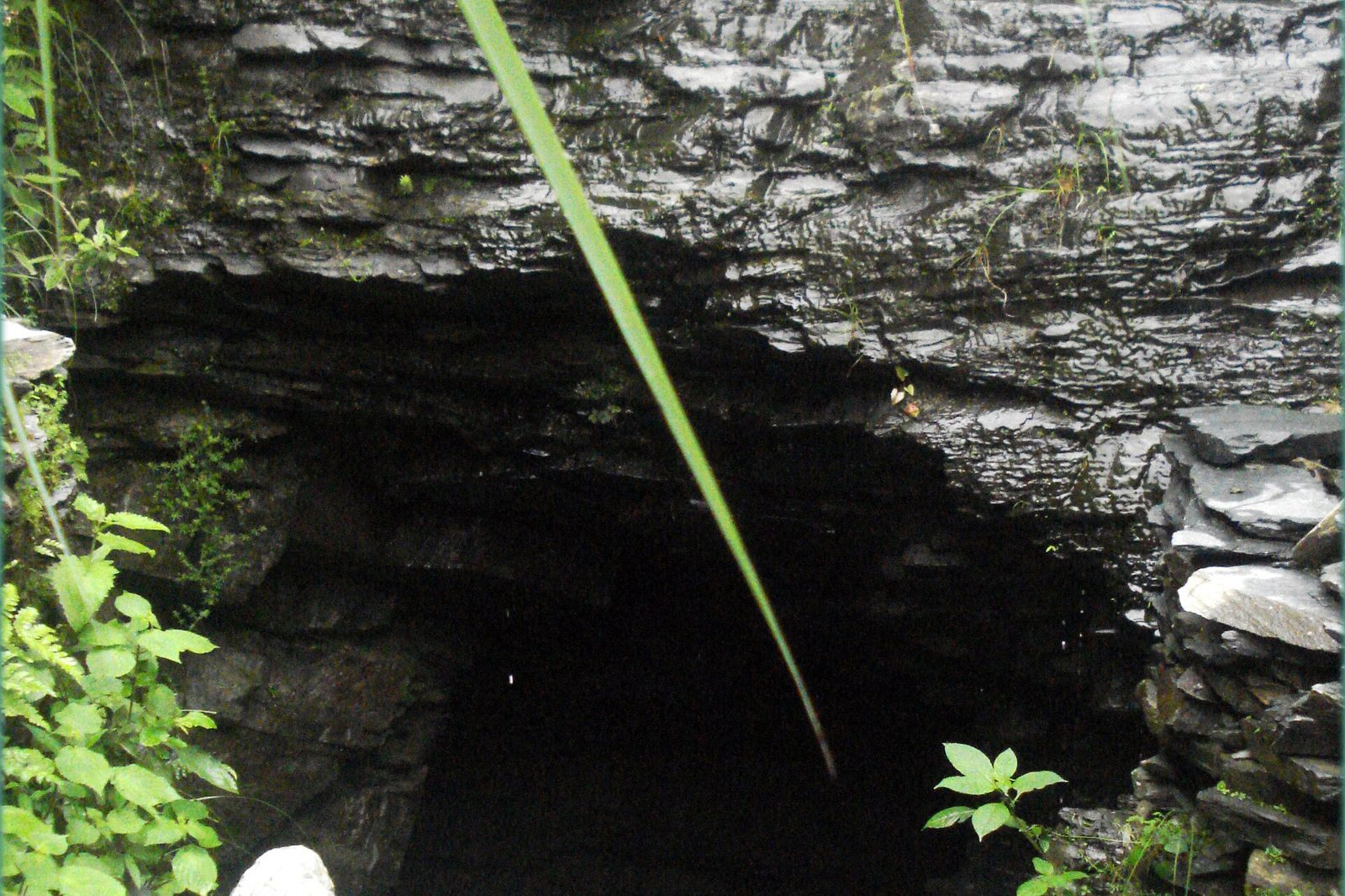
- Openings into the hill: photos from Khaniyara (above) show dark openings cut into the layered rock, so some workings went into the hillside, not only down.
- Explosives: the same studies say workers often blasted hard rock, frequently with "very limited safety precautions". A 2023 study in the ISVS e-journal by Raman Kant and Harshit Sosan Lakra (IIT Roorkee) notes that "detonators are occasionally used" to break large stones before hand work.
- Waste: slate quarrying throws away a lot of stone. A 1997 Central Mining Research Institute study found up to about half of the material is wasted in extraction, cutting and dressing; other estimates quoted by Chand et al. run to 50 to 70 percent. The grey screes of broken slate below old pits are that waste.
- Season: workers spent the summer season deep in the valleys, and many came from far away: Nepal, Jammu and Kashmir, Lahaul-Spiti and Chamba.
We found no source describing machine sawing or a modern slate factory at Khaniyara. All the accounts describe hand work, plus explosives.
How are slate roof tiles split, cut and shaped?
Once a block is out, the rock’s cleavage does most of the work. The sources say the slates "are split along cleavage and dressed into various sizes", and that the sizing "is done by manual labour". In plain steps:
| Step | What happens | Tools | Source |
|---|---|---|---|
| 1. Extraction | A block is levered or broken out of the slate band in a pit or opening | Crowbar, chisel, digging tools; sometimes explosives | Chand et al. 2017; Himachal Watcher 2018 |
| 2. Breaking down | Large, hard blocks are broken into pieces small enough to work by hand | Hand tools; detonators "occasionally" | ISVS 2023 |
| 3. Splitting | The block is split along its natural cleavage into thin sheets | Hand tools such as chisels | Chand et al. 2017 |
| 4. Dressing | Edges are trimmed so each sheet becomes a usable roof slate; sizes vary and price depends on smoothness and quality | Hand dressing | Chand et al. 2017 |
| 5. Carrying | Slates go down the mountain on ponies, about 100 slates per trip; a pony cost Rs 200 to 300 a day in 2013 | Ponies and mules | Chand et al. 2017 |
| 6. Stocking and sale | Slates are stacked at roadside depots; a "slate godown" on the Dharamshala-Khaniyara road is mentioned in 2001 | Trucks | The Tribune 2001 |
| 7. Roofing | Slates are laid in overlapping rows on a sloping timber roof frame, as the photos here show | Skilled roofers and carpenters | ISVS 2023; The Tribune 2025 |
Sizes and thickness: we could not find any published standard size or thickness for Kangra roof slates. Sizes vary by quarry and by order, and slates are priced by quality. If you need exact sizes for a building project, ask a local mason or supplier and see the stone before you buy.
Why do Kangra houses have slate roofs?
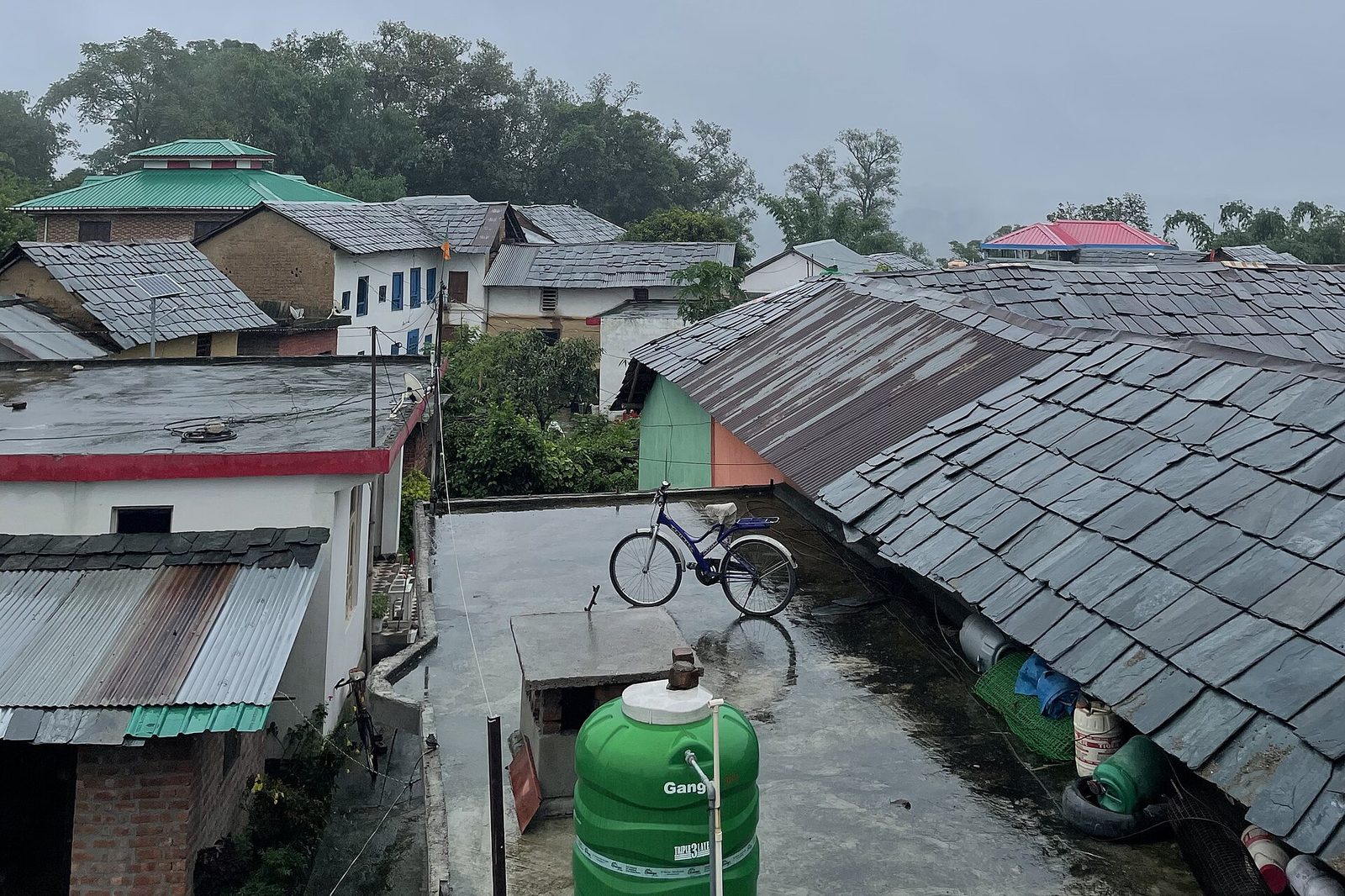
Because the stone was on the doorstep. A 2025 Tribune report from Palampur calls slate roofing "a hallmark of the Kangra valley", made affordable by skilled local carpenters and easily available materials. A slate roof is heavy, does not burn, and sheds the long monsoon rain.
What the sources record about the traditional Kangra house:
- Roof: "a slanted wooden roof with slate stone", with slates placed "without any braces", according to the 2023 ISVS study.
- Walls: load-bearing walls 450 to 600 mm thick of undressed slate stone laid without mortar (dry stone), with mud plaster inside.
- Floors and fences: slate is also used for paving, flooring and fencing, and the crude, rough-split kind goes into masonry in the timber-and-stone kath-khuni style, according to Kaur et al. (2020).
- Gaddi homes: in Gaddi villages around Dharamshala, thick stone and mud walls carry heavy grey slate roofs; see our Gaddi culture guide.
- Further afield: the IUGS lists Himachal slate in the 10th-century Laxmi Narayan temple and the Champavati temple in Chamba, the Mathi temple at Chitkul, and British-era buildings on the Mall in Shimla such as the Gaiety Theatre and the Town Hall. Pragpur, declared India’s first heritage village in 1997, is known for its slate-roofed lanes.
- A 2015 example: The Tribune reported in August 2015 that Priyanka Gandhi Vadra picked slate from the Khaniyara mines, after comparing slate from Mandi, Chamba and Dharamsala, for her house roof at Charabra near Shimla.
What about St John in the Wilderness? The 1852 church near McLeod Ganj is built of dark stone, but recent photos show it with a painted metal-sheet roof, not slate. We found no reliable source on what its original roof was made of, so we do not claim it was slate.
Why slate roofs are disappearing: the same 2025 Tribune report lists the high cost of installation and upkeep, the need for skilled labour, fewer traditional carpenters, costly timber under strict forest laws, and "government restrictions on quarrying and transporting slate". Concrete and metal sheets are quicker and cheaper.
Who worked the Khaniyara slate, and what was it worth?
Khaniyara’s slate made it one of the richest villages in Himachal for a while. The history below comes mainly from the 2017 Chand et al. case study (which draws on Nesar Ahmad’s 2007 study) and from the state survey; where they differ we say so.
| Period | What happened |
|---|---|
| About 1850 | Mining starts along the Manjhi (Maunjhi) and Manuni (Manauni) khads, per the state survey. Locals told researchers it began around 1855 |
| 1867 | R. W. Shaw sets up the Kangra Valley Slate Company, working 146 ha (366 acres): 204 acres in Manuni khad and 162 acres in Manjhi khad, until Independence |
| 4 April 1905 | The Kangra earthquake flattens Khaniyara along with Dharamshala and McLeod Ganj; photographs of Khanyara in ruins survive |
| 1930 | A dispute over company payments to villagers reaches the Lahore High Court, which rules for the village, per Chand et al. |
| 1950s | Under the Punjab Village Common Lands (Regulation) Act 1953, the Khaniyara and Dari panchayats get control of the common land and lease out quarries to villagers |
| 1973 | The Khaniyara-Dari Slate Quarry Board (pradhans of both panchayats in rotation) starts granting 11-month leases: as many as 650 leases over about 625 ha, with more than 400 pits worked by hand |
| 1977 | When the village bank branch opened, a mule driver in the mines earned Rs 500 a month, more than a new bank clerk’s Rs 480, according to the branch manager quoted in 2017 |
| 1990s | About 10,000 people depended on the quarries directly or indirectly (The Tribune 1998 and 2001) |
The board used its income for roads, a rest house for miners, a small hospital and schools. Chand et al. quote an estimate of panchayat earnings of up to Rs 5 lakh a year. In a December 2013 survey of 45 stoneworkers at the quarries, 42 depended entirely on mining. Wages then were Rs 200 for a 9 am to 3 pm shift and Rs 300 for working until 5 pm.
Is slate mining banned in Dharamshala?
Short version: quarrying at Khaniyara has been illegal for most of the last 30 years, except under a narrow 25-hectare permission that lapsed in 2014. Slate can only be mined legally under a lease, and because most of the slate land is recorded as forest, any lease there also needs central forest clearance under the Forest Conservation Act, 1980. The timeline, with the gaps in the record:
| Date | Event | Source |
|---|---|---|
| October 1995 | Villagers ask the High Court to act against slate quarries threatening the area’s ecology. The court orders the forest department to demarcate forest land to stop illegal quarrying in the neighbouring Kembal forest. The State Pollution Control Board says it will stop clearing quarry permits from February 1996 | Down To Earth, 14 Oct 1995 |
| About 1996-97 | The quarries are shut by court order. The Tribune (2008) says the Himachal Pradesh High Court banned slate mining in Khaniyara on a PIL; a 2013 study dates the High Court closure to 1997; Chand et al. (2017) instead give a Supreme Court ban on 13 September 1995. Sources disagree on which court and the exact date | The Tribune 2008; Chand et al. 2017 |
| October 1998 | The Tribune reports the ban is being ignored and "illegal mining is in full swing"; 140 ha in A and B zones await central forest approval | The Tribune, 25 Oct 1998 |
| Late 2000 | The Union Ministry of Environment and Forests clears slate quarrying on 25 ha of forest land at Khaniyara, on condition of compensatory planting on 50 ha and an Environmental Management Plan; about 115 lessees apply | The Tribune, 11 Jan 2001 |
| February 2001 | Chief Minister P. K. Dhumal, speaking at Aghanjar Mahadev near Khaniyara, says the government will consider restoring mining rights to the panchayats | The Tribune, 16 Feb 2001 |
| 2002 | The Supreme Court allows mining on the 25 ha of forest land, conditional on the state first depositing the net present value (NPV) of the land. The Tribune (2008) says the land was allotted for 30 years | The Tribune 2015 and 2008 |
| 2008 | Six years on, the land is still not allotted; Khaniyara has split into nine panchayats that cannot agree on sharing royalties; illegal mining grows | The Tribune, 1 Oct 2008 |
| 31 Jan to 13 Mar 2014 | The ministry gives the state until 13 March 2014 to deposit about Rs 1.6 crore NPV with CAMPA, or lose the ad hoc permission. It is not paid and the right to mine lapses | The Tribune 2015 and 2018 |
| July 2015 | Illegal mining on the forest land reported to be continuing | The Tribune, 27 Jul 2015 |
| April 2018 | In a PIL first filed in 2015 by Ghazala Abdullah on construction and environmental damage in Dharamshala, the Himachal Pradesh High Court (Acting Chief Justice Sanjay Karol and Justice Ajay Mohan Goel) finds the mining officer’s claim of no illegal mining at Khaniyara prima facie false, after its local commissioner reported active illegal mining on Khaniyara Road | Himachal Watcher, 7 Jul 2018; The Tribune, 23 Apr 2018 |
| November 2019 | Kikar Singh, 69, of Khaniyara dies while blasting rock for slate; police book the contractor under IPC sections 304-A and 336 and the Explosives Act. Unnamed sources say the NPV had since been paid but the land was never demarcated, so mining there was still illegal | The Tribune, 14 Nov 2019 |
What we could not confirm: the exact case numbers and wording of the 1990s court orders; whether the NPV was ever paid; and whether any legal slate lease is working at Khaniyara in 2026. A Himachal Industries Department survey, prepared after 2016, said the department could not auction slate quarries "due to Forest Conservation Act, 1980", that only 12 slate quarries were working in the whole state, all on private land or on land with forest clearance, and that slate production had fallen. We found no news of a fresh court order, lease auction or reopening at Khaniyara between 2020 and October 2026.
What are the environmental and safety problems?
- Blasting and deaths: blasting by skilled and unskilled workers with little protection has caused fatal accidents, and the 2019 death of Kikar Singh is the best documented case.
- Rockfall and landslides: the High Court’s local commissioner reported in 2018 that unscientific digging and heavy explosives had cracked the rock above the pits, with no mine plan, rockfall that allegedly caused casualties in villages below, silted streams, more erosion and landslides, and waste dumped on slopes.
- Rivers: the 1997 court case against the quarries claimed they were polluting the Beas and Ravi rivers, according to Chand et al. (2017).
- Forest loss: much of the quarry land is forest, which is why central clearance is needed. Locals told researchers there was never a clear line between forest and mining land.
- Waste: up to half or more of the stone dug out is wasted. The commissioner suggested removing waste from slopes, re-grassing with local species and vetiver, check dams and gabions, no mining on slopes steeper than 45 degrees, and turning slate waste into concrete blocks.
The Geological Survey of India published an early study of the problem: Roy, Srivastava and Singh, "Geo-Environmental Impact Assessment of Slate Mining in Kangra District, Himachal Pradesh" (GSI Special Publication 21, 1996).
Where can you see slate roofs and old quarries near McLeod Ganj?
You do not need to go near a pit to see Kangra slate. Look at the roofs.
| Where | What to look for | Distance | Notes |
|---|---|---|---|
| Khaniyara village and Aghanjar Mahadev temple | Old slate-roofed houses; the scarred quarry slopes are visible above the village | Khaniyara is about 7 km from Dharamshala (The Tribune) | Stay on the road and temple paths; do not walk up into the khads |
| Dharamkot | Old village houses among the guesthouses, on top of a mapped 210 m slate horizon | 2 to 3 km from McLeod Ganj | See our Dharamkot guide |
| Naddi and Tota Rani | Slate-roofed Gaddi houses, terraced fields, Dhauladhar views | Naddi is about 3 km from McLeod Ganj | See our Naddi and Dal Lake guide |
| Kareri village | Slate-roofed houses on the way to Kareri Lake | About 25 km by road from Dharamshala, then on foot | See our Kareri Lake trek guide |
| Pragpur heritage village | Lanes of old houses and shops under blue-black slate | Southern Kangra district; a long day trip | Combine with other stops in places to visit in Kangra |
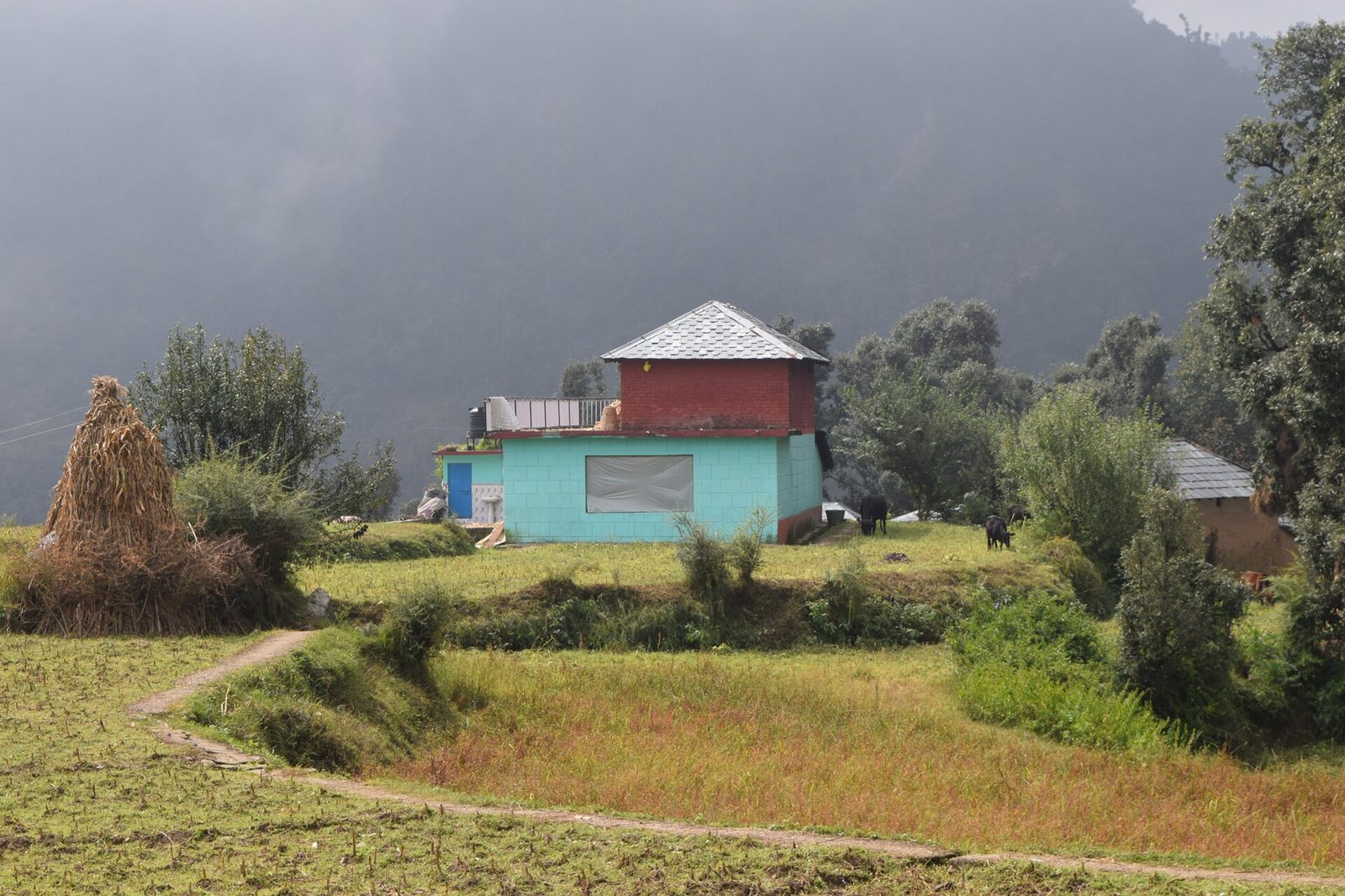
Look closely and you will see two styles: plain overlapping rows, and slates laid diagonally in a scale or diamond pattern, often with a metal cap along the ridge, as on the Kareri house above.
How to visit respectfully and safely:
- Do not enter pits, openings or slate screes. Old workings can collapse, loose slate slides underfoot, and blasting may still happen illegally.
- Do not take slate. It is a mineral on forest or private land, and removing it is not allowed.
- Houses are homes. Ask before photographing people or stepping into a courtyard, and do not climb on walls or roofs.
- Avoid the khads in the monsoon (roughly July to mid-September), when streams flood and slopes slide.
- Go with a local. A local guide or a driver from the area can show you the village and the view of the old workings from a safe place. Our treks page has guided walks around Dharamshala.
Getting there: Khaniyara is on the eastern side of Dharamshala. From McLeod Ganj or Kotwali Bazaar the easiest way is a local taxi; see our taxi services. For a village stay near the slate country, look at homestays on our hotels page.
Glossary of local terms
| Term | Meaning |
|---|---|
| Khad | A mountain stream and its valley, as in Maunjhi, Manauni and Churan khads |
| Dhar | A ridge or spur, as in Dhauladhar and Thatharna Dhar |
| Shamlat | Village common land, held by the panchayat; much of the old quarry land was shamlat |
| Kath-khuni | Traditional Himachali building style of alternating courses of timber and stone |
| Panchayat / pradhan | Village council / its elected head; the Khaniyara and Dari pradhans ran the slate board |
| Slate godown | A roadside depot where slates were stacked for sale |
| NPV / CAMPA | Net present value: the fee paid for using forest land, deposited with the Compensatory Afforestation fund authority |
| FCA | The Forest Conservation Act, 1980, which needs central approval before forest land is used for mining |
What is the state of Kangra slate in 2026?
- Confirmed: the slate belt is mapped and well described; Himachal slate has international heritage stone status (IUGS, 2024); slate roofs are declining (The Tribune, February 2025); legal slate quarrying in Himachal is limited by the Forest Conservation Act.
- Not confirmed: whether any legal slate quarry is working at Khaniyara today, and whether illegal mining has stopped. The most recent detailed reports we found are from 2018 and 2019.
- For builders and restorers: if you need slate for a repair, buy only from a licensed supplier and ask where it was quarried. We have no reliable current price to quote.
For more of the valley’s heritage, read our Kangra painting and art guide, and if you are planning a trip, see our hotels, taxis and treks.
Frequently Asked Questions
Where does Kangra slate come from?
How old is the slate around Dharamshala?
Is slate mining banned in Dharamshala?
How is Kangra slate quarried and split?
Why do old Kangra and Gaddi houses have slate roofs?
Can tourists visit the Khaniyara slate mines?
Does St John in the Wilderness church have a slate roof?
Where can I see slate roofs near McLeod Ganj?
More answers on our Dharamshala travel Q&A page.
Where to stay: see our picks of the best hotels in Dharamshala and the best hotels in McLeod Ganj, or compare all hotels and homestays with direct rates.
Need Help Planning Your Dharamshala Trip?
Our local team can help with hotels, treks, taxis, and custom itineraries.
Sources
Checked 2026-10-20. Facts change; confirm on the official pages before you travel.
- Himachal Slate: IUGS Global Heritage Stone Resource listing (International Union of Geological Sciences, designated 2024)
- Kaur G., Bhargava O.N. et al., Proterozoic Slates from Chamba and Kangra: a Heritage Stone Resource from Himachal Pradesh, India (Geoheritage 12, 2020)
- Study on the drainage system, mineral potential and feasibility of mining, District Kangra (HP Directorate of Industries, Geological Wing)
- Brief Industrial Profile of Kangra District 2016-17 (MSME Development Institute, Government of India)
- Chand J., Kumar P., Devi P., Changing Structure of Mining in Himachal Pradesh: A Case Study of Khanyara Slate Mines (European Academic Research, November 2017)
- Kant R., Lakra H.S., Vernacular Construction Techniques of the Kangra Region of Himachal Pradesh (ISVS e-journal 10(1), January 2023)
- A clean slate: Khaniyara villagers move the High Court (Down To Earth, 14 October 1995)
- Ban on Khaniyara slate quarrying ignored (The Tribune, 25 October 1998)
- Khaniyara slate mining: 25 ha cleared, conditions pending (The Tribune, 11 January 2001)
- Dhumal on restoring Khaniyara mining rights to panchayats (The Tribune, 16 February 2001)
- Riches to rags: Khaniara after the slate ban (The Tribune, 1 October 2008)
- Illegal slate mining goes on in Dharamsala (The Tribune, 27 July 2015)
- Priyanka’s house to have Dharamsala slate on roof (The Tribune, 9 August 2015)
- Mining persists in Khaniara despite SC orders (The Tribune, 23 April 2018)
- High Court local commissioner on illegal slate mining in Khanyara (Himachal Watcher, 7 July 2018)
- Illegal slate mining claims villager’s life at Khaniara (The Tribune, 14 November 2019)
- Kangra’s hill architecture fading away amid modernisation (The Tribune, 5 February 2025)
- Quick guide: Pragpur, Himachal Pradesh (Outlook Traveller)
- Photograph of the ruins of Khanyara after the 1905 Kangra earthquake (Wikimedia Commons, public domain)
- International Chronostratigraphic Chart (International Commission on Stratigraphy)
Related Guides
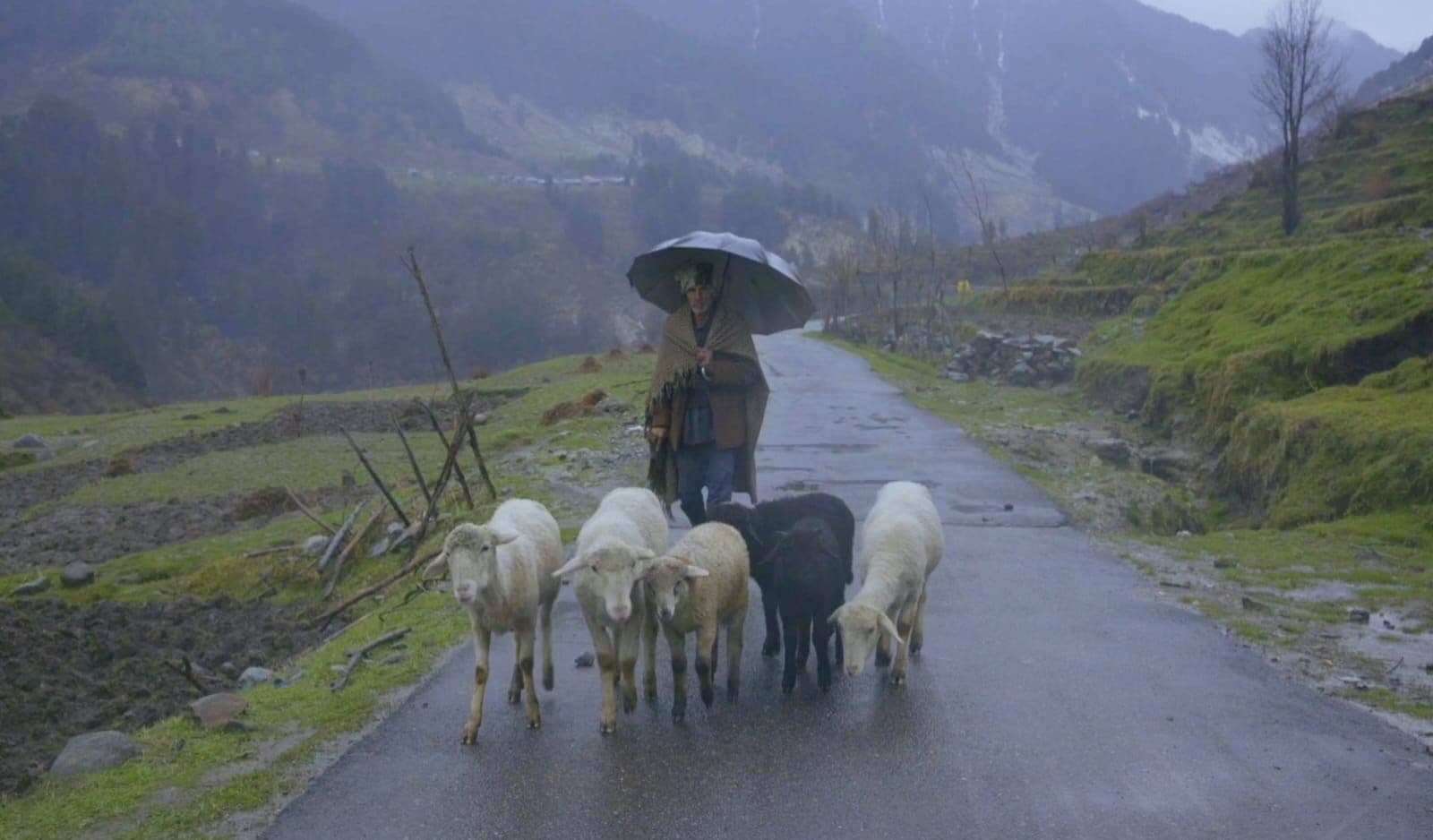
The Gaddi Shepherds of the Dhauladhar: Culture, Migration & Etiquette (2026)
Who the Gaddi people are, how their flocks cross the Dhauladhar passes each year, what their dress and Shiva devotion mean, and how to meet shepherds respectfully on the trails around Dharamshala.
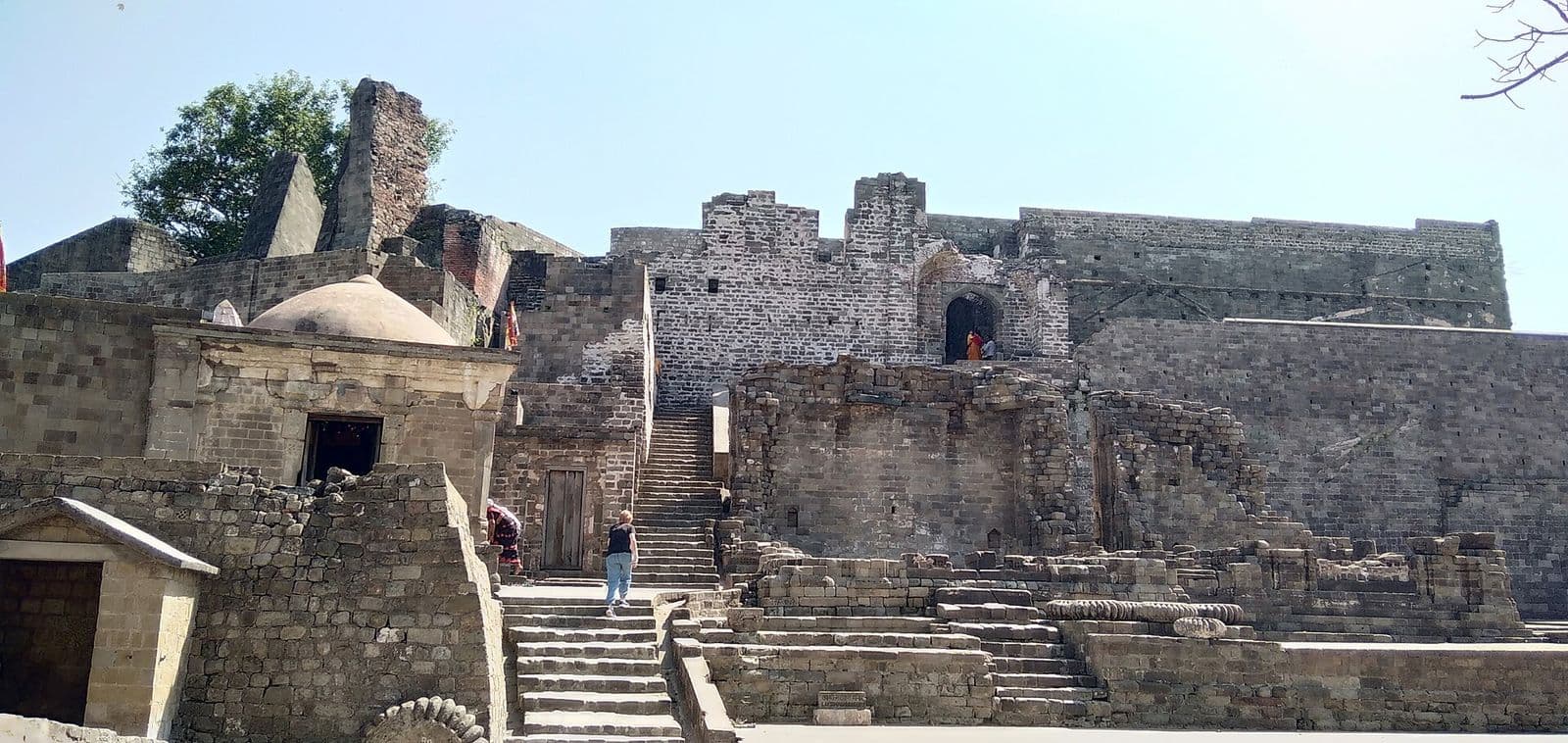
Places to Visit in Kangra (2026): Fort, Temples, Masroor and a 1-Day Loop
Kangra Fort, Brajeshwari Devi, the Masroor rock-cut temples, Chamunda, Jwalamukhi, Baijnath and Pong Dam, with distances from Dharamshala, timings, entry fees and a practical one-day Kangra loop.
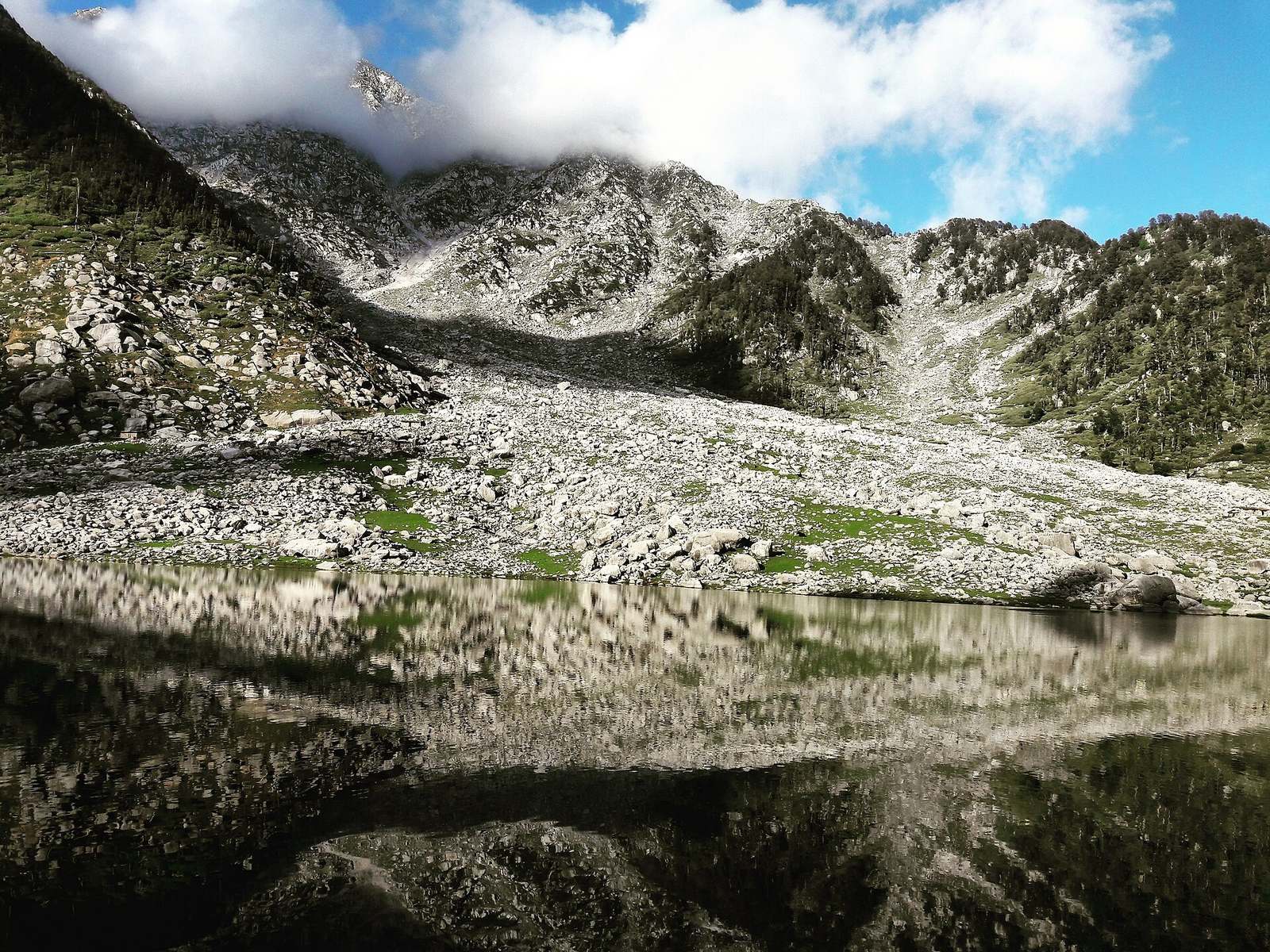
Kareri Lake Trek Guide: Route, Distance, Best Season & Tips (2026)
Everything you need for the Kareri Lake trek near Dharamshala: the route from Kareri village via Reoti, distances, altitude, difficulty, best months, permits, camping and safety.
Kangra Painting & Art Guide: Miniatures, Museums, Andretta & Norbulingka (2026)
The story of Kangra miniature painting under Raja Sansar Chand, where to see it around Dharamshala, how to buy a genuine piece, and the art trail from Norbulingka thangkas to Andretta pottery.